
Stainless steel, nitriding and corrosion resistance – part 2
The polarization curves (CP) are complementary techniques to the one described above (OCP), but in this case the parameters obtained are of the kinetic type. A bias curve corresponds to a variation curve of the current density (i) with respect to the electrode potential (E), for a specific electrode-electrolyte combination, or, in other words, a logarithmic graph of current (i) Vs electric potential (E). As mentioned before, a complete polarization curve (cathodic + anodic) constitutes the basic kinetic law for any electrochemical reaction.
CPs are useful for quantifying the behaviours of metals under various conditions and for passive systems they can exhibit active / passive and / or passive / trans-passive transitions.
Polarization curves should only be determined after the potential of the test metal’s open-loop electrode has reached a stationary value. The time it takes to reach steady state depends on the nature of the system.
The combined measurement of the potential and current relationships for a corrosion cell operating over a wide range of oxidizing conditions produces polarization curves that describe the electrochemical reactions. The combined measurement of potential and current has useful applications in corrosion control.
The combinations of cathode and anodic curves (full CP) are shown in graphs “3” & “4”.
It can be observed how the kinetic parameters of the corrosion of the nitrided samples, extrapolated with cathodic and anodic Taffel curves, are arranged on the region of the most negative values and with a higher current density. This indicates better corrosion resistance than samples without a nitriding layer. This behaviour is typical of the corrosion inhibiting metal layers deposited on the surface. In general, all results suggest that chloride ions do not rapidly penetrate the compact nitride barrier and sulphate ions, at low and neutral pH, show the same trend.
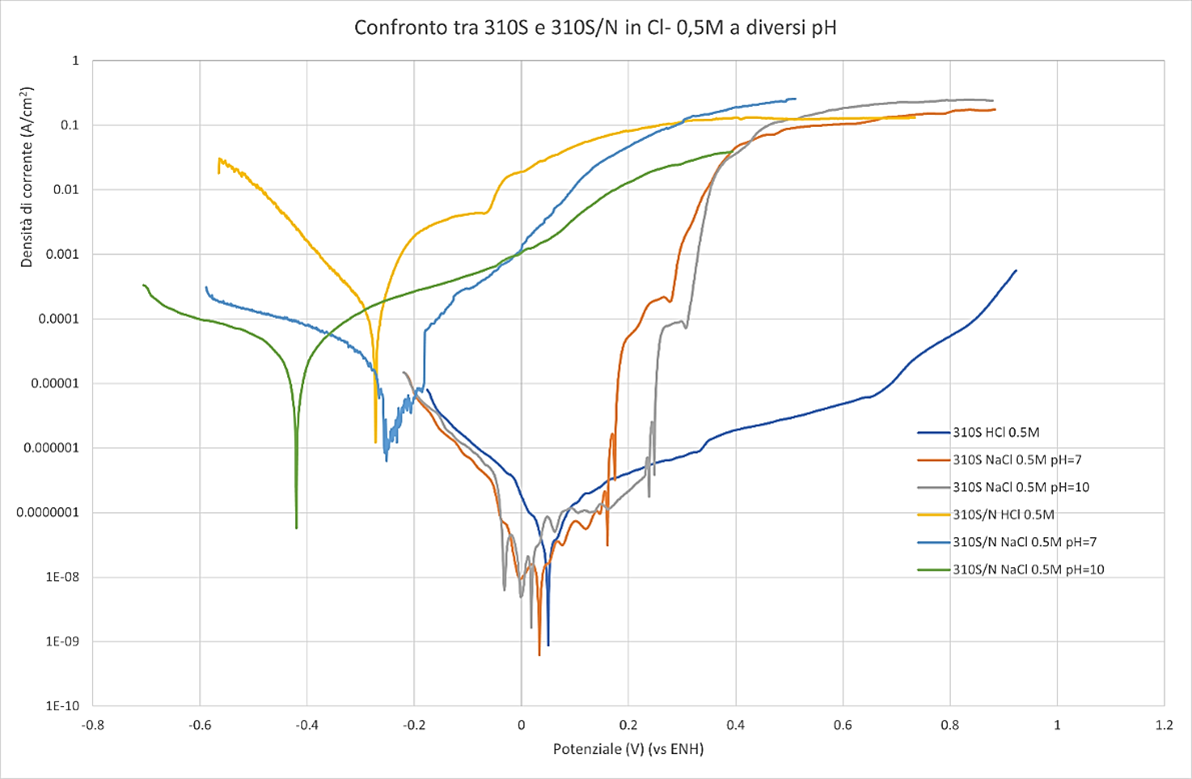

310S nitrided (310S/N) in the presence of: 0.5M H2SO4, 0.5M Na2SO4 pH = 7 and 0.5M Na2SO4 pH = 10. T=65°C
In conclusion, we can reasonably state that the OCP and CP measurements reveal that the presence of a nitriding layer on the AISI 310S material, in the presence of Cl– and SO4-2 ions, at a temperature of 65 ° C, works well as an inhibitory anticorrosive barrier, obviously if the nitride barrier (depth of nitriding) is regular and constant.